Uncertainty Estimations
When HSF is used in bagging mode or with test-time augmentation (see the configuration page),
it is possible to estimate the uncertainty of the predicted segmentation, notably through the Aleatoric Uncertainty
which depends on noise or randomness in the input testing image.
Uncertainty maps are saved in the relative directory difined by files.output_dir.
Aleatoric Uncertainty
Aleatoric uncertainty is also known as statistical uncertainty, and is representative of unknowns that differ each time we run the same experiment1.
The uncertainty is estimated by measuring how diverse the predictions for a given image are. Wang et al., 2019.
Given a set \(Y\) of \(i\) predictions, in HSF the voxel-wise Aleatoric Uncertainty \(H(Y^i|X)\) is defined as2:
where \(\hat{p}^i_m\) is the frequency of the \(m\)th unique value in \(Y^i\).
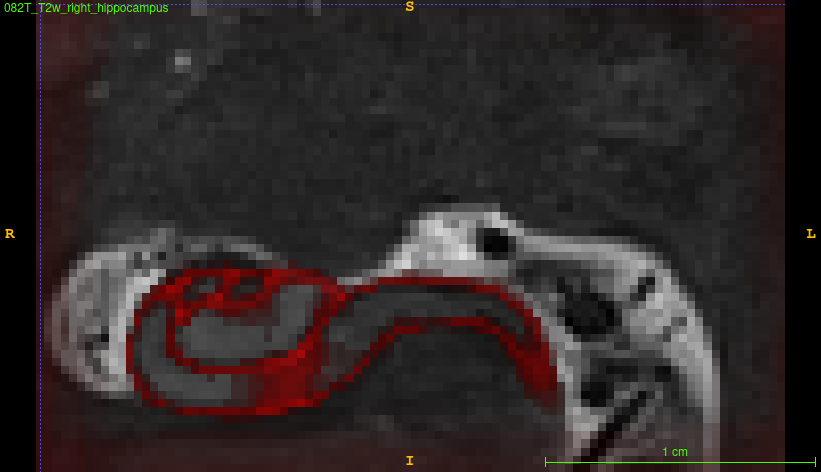
For example, here is an output uncertainty map:
-
https://www.wikiwand.com/en/Uncertainty_quantification ↩
-
Wang, G., Li, W., Aertsen, M., Deprest, J., Ourselin, S., & Vercauteren, T. (2019). Aleatoric uncertainty estimation with test-time augmentation for medical image segmentation with convolutional neural networks. Neurocomputing, 338, 34–45. https://doi.org/10.1016/j.neucom.2019.01.103 ↩